
Honoring the states we serve · Florida
Castillo de San Marcos: The Stone Fort That Guarded St. Augustine for Three Centuries
On the shore of Matanzas Bay in St. Augustine, Florida, stands a star-shaped fortress built of seashell stone more than three hundred years ago. The Castillo de San Marcos is the oldest masonry fort in the continental United States, and in all its history it was never taken by force.
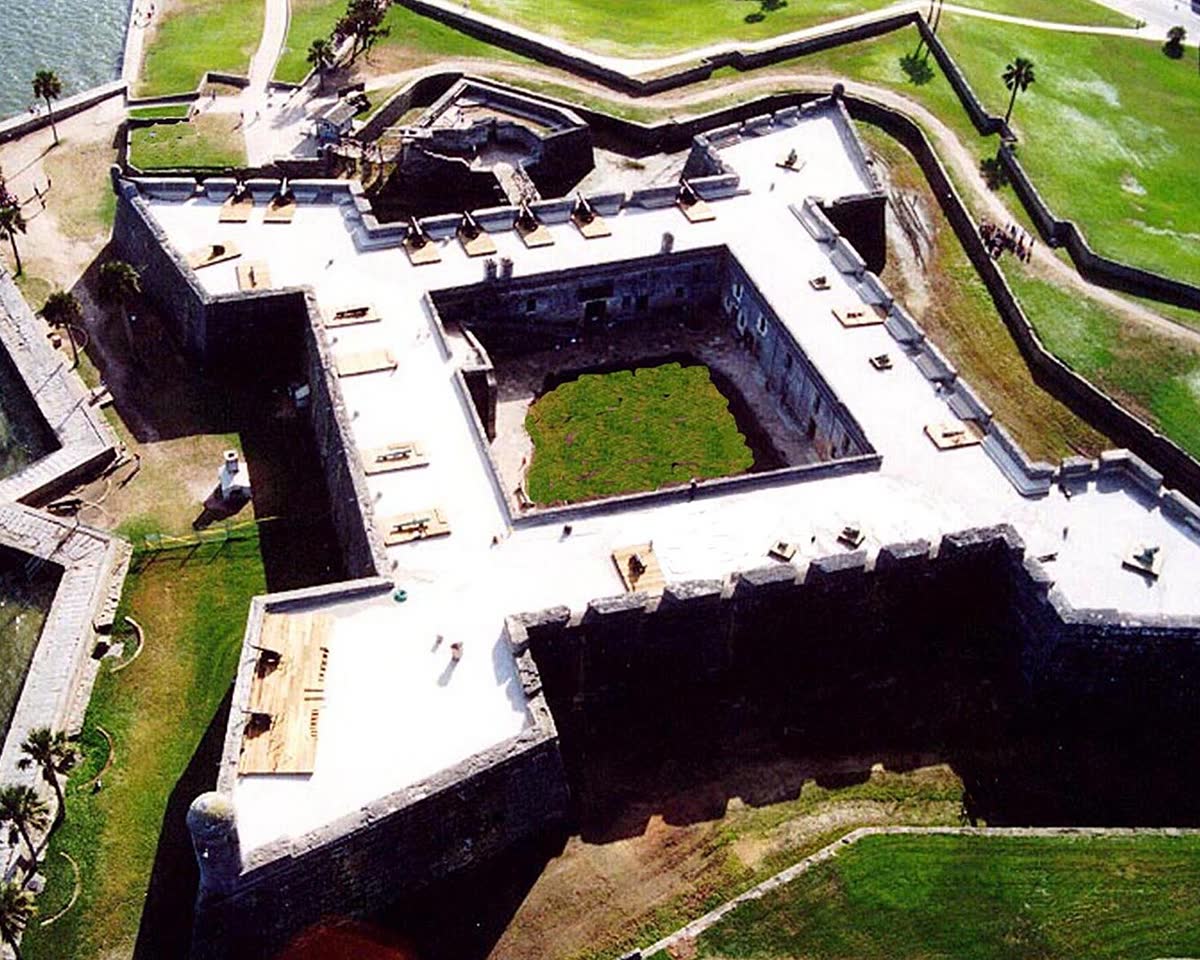
Guarding the oldest city in the United States
St. Augustine was founded in 1565 by Pedro Menéndez de Avilés for the Spanish Crown, making it the oldest continuously inhabited European-founded city in the continental United States. For its first century the town was protected by a series of wooden forts. After pirates raided the city in the 1660s, Spain ordered a fort that could not burn.
Construction began in 1672, and the core of the fortress was completed in 1695. Its builders used coquina, a local stone made of tiny compressed seashells. Coquina turned out to be remarkably effective: instead of shattering, its soft, porous walls absorbed cannonballs.
Tested by siege, never taken
In November 1702, English forces from Carolina besieged St. Augustine and burned much of the town. The townspeople took shelter inside the Castillo, and its walls held. In 1740, General James Oglethorpe of Georgia arrived with soldiers and a fleet of British ships and laid siege again. Once more the fort held, and the attackers withdrew.
Many flags, many names
The Castillo has flown the flags of several nations. Spain gave Florida to Great Britain in 1763, and the British renamed the fort Fort St. Mark. Spanish troops returned in 1784. When Florida passed to the United States in 1821, the fort was renamed Fort Marion.
Its history includes painful chapters too. In the 1800s the U.S. Army held Native American prisoners here, including Seminole leaders during the Second Seminole War and, beginning in 1875, members of Plains nations from the western frontier. Remembering them is part of honoring the full story of the place.
In 1924 the fort was declared a National Monument. The National Park Service took over its care in 1933, and in 1942 Congress restored its original name: Castillo de San Marcos.
Planning your visit
- Address: 1 South Castillo Drive, St. Augustine, FL 32084.
- Hours, fees and programs: check the National Park Service website before you go.
- Nearby: St. George Street and the historic district, the Bridge of Lions, and the Matanzas Bay waterfront are all within walking distance.
Making a home in Florida
From historic St. Augustine to Jacksonville, Orlando, Tampa and Miami, Florida draws families from across the country and around the world. Beyond Financing, Inc. is licensed in Florida as a mortgage broker and correspondent lender. Whether you are buying your first home, are self-employed, file taxes with an ITIN, or live outside the United States, our team will compare programs from several lenders and explain every step in English, Português or Español.
Talk with our teamEstimate a monthly payment
More stories from the states we serve →
Sources
- National Park Service, Castillo de San Marcos National Monument
- Wikipedia, "Castillo de San Marcos"
Part of our series honoring the communities in the nine states where Beyond Financing, Inc. is licensed. Beyond Financing, Inc., NMLS #2394496. Equal Housing Opportunity. This is not a commitment to lend; all loans are subject to credit approval and program guidelines. Not affiliated with the National Park Service or Beyond Finance, LLC.